Poster · United Kingdom · c. 1915 · World War I
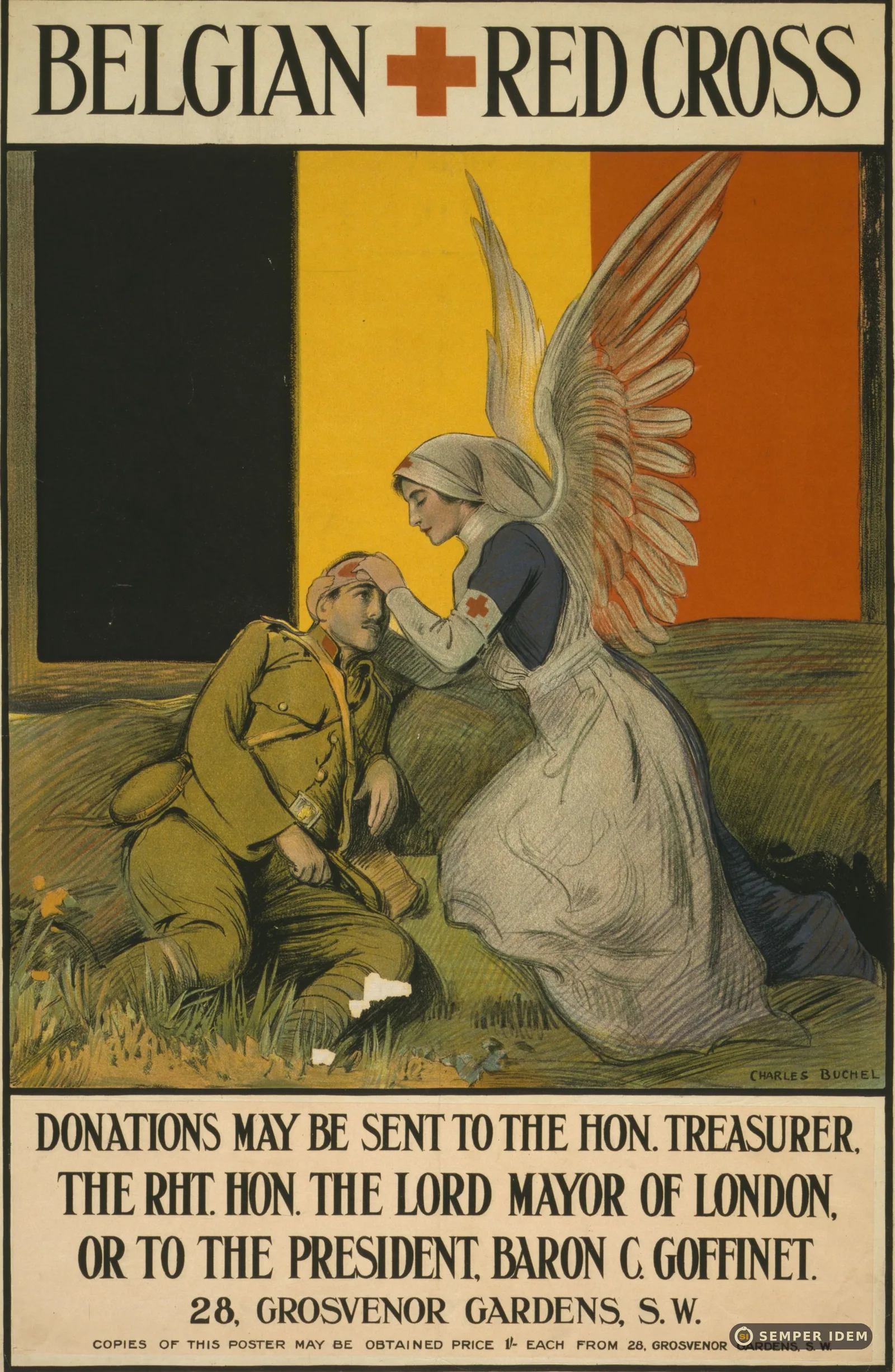
Belgian Red Cross
By 1914 the world already had a symbol of war crimes: Leuven.
- Themes
A nurse with angel's wings bends over a wounded Belgian soldier against the Belgian flag. The poster raises money for the Belgian Red Cross. Germany had invaded neutral Belgium; in Leuven the university library was burned and some 250 civilians were killed, in Dinant 674. Britain took in around 250,000 Belgian refugees.
Semper Idem · today’s parallel
Britain welcomed the Belgians warmly, but sympathy burned out fast. By 1915 Britons were complaining about housing shortages and foreign habits, and in Fulham, London, it came to anti-Belgian riots. People also asked: why are Belgian men in London and not at the front? Today the same question is asked in Poland and Germany — about Ukrainian men of fighting age. Back then the tension was eased not by moral appeals but by work: Belgians were taken on in munitions factories. Sympathy burns out fast; solidarity holds when everyone has a place in a common cause.
How much global solidarity do you think is left?
Context
United Kingdom, c. 1915. Artist: Charles August Buchel (Karl August Büchel, 1872–1950), a theatrical portrait painter. Printed by Johnson, Riddle & Co., London. The poster appealed for donations to the Belgian Red Cross fund.
In August 1914 Germany invaded neutral Belgium. Mass executions of civilians (Dinant, Leuven) and the burning of the Leuven University library became symbols of “the Rape of Belgium”. Some 250,000 Belgian refugees came to Britain.